
From Reactive to Proactive: Get Ahead of Supply Disruptions
GHX sees around 1 million backorder signals across its network each month. For supply chain teams, the challenge isn't simply knowing disruptions are happening — it's determining which ones need attention and where to act first.
GHX Resiliency Center is already embedded in your workflows.
Built on the trusted data view that GHX provides.

Customer Story
Trusted collaboration, not just visibility
Robert Milano of Sarasota Memorial Health Care System and Troy Kirchenbauer of LeeSar break down how they partnered with GHX to help build Resiliency Center — a two-sided communication hub for disruption management, built for the whole GHX community. AI-powered insights, near real-time supply chain data and coordinated communication gave them clearer visibility into disruptions, substitutions and backorders, with less manual effort and faster decisions.
Watch their Summit Session to learn how providers and suppliers are using AI and connected intelligence to strengthen healthcare supply chain resilience.
Disruption Management for Supply Chain Continuity

Earlier disruption surfacing
See risk sooner, before it hits your supply chain

Compliant alternative sourcing
Suggested options, ready to act on

Centralized supplier communication
One thread, not a dozen inboxes
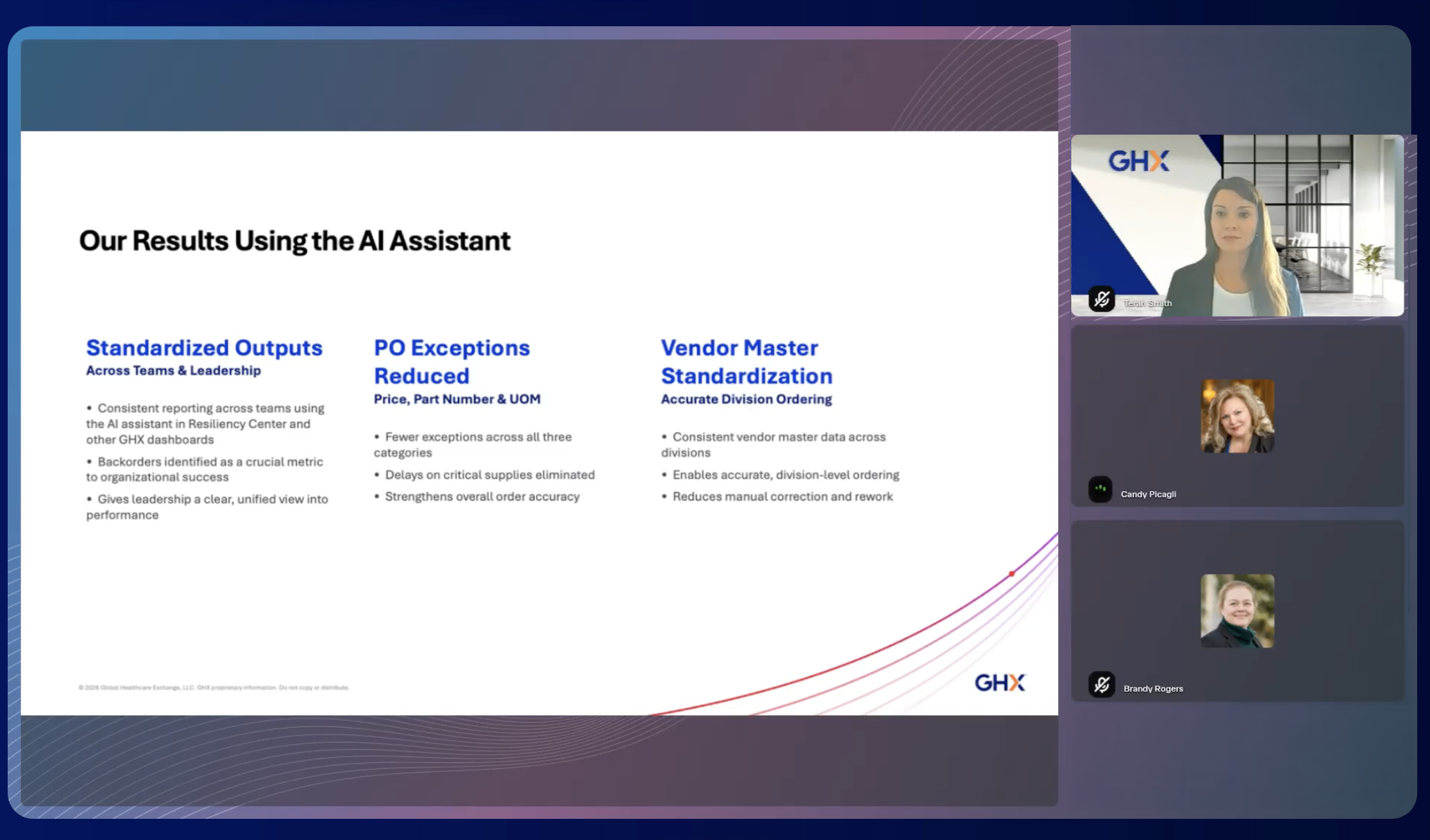
Customer On Demand Webinar
See how your peers are putting Resiliency Center to work
Hear directly from supply chain leaders at Presbyterian Healthcare Services and Eskenazi Health on how they're using GHX ResiliencyAI and Resiliency Center to manage backorders and disruptions.
- Brandy Rogers, Purchasing Agent, Procure to Pay, Presbyterian Healthcare Services
- Helen Langford, Sr. Purchasing Agent, Procure to Pay, Presbyterian Healthcare Services
- Candace Picagli, SCM Systems Analyst, Eskenazi Health
Frequently Asked Questions
The GHX Resiliency Center helps healthcare providers and suppliers anticipate supply chain disruption, respond faster, and recover with less impact to patient care. It brings together data and intelligence from across the GHX exchange so risk gets caught earlier and alternates get found faster.
Workflow debt is the manual coordination, rework, and delays created by gaps across systems, workflows, and organizations in the healthcare supply chain. It builds up over time and slows down how quickly a team can respond to disruption. Reducing workflow debt is a core part of building a more resilient supply chain.
GHX connects providers and suppliers on one exchange and uses connected intelligence to sense signals across that network. This allows teams to anticipate disruption earlier, decide on the right response, and act faster than they could relying on manual processes alone.
Resiliency is an ongoing capability, not a one time fix. Building the muscle to sense risk, respond quickly, and learn from every disruption is what allows a supply chain to stay steady over time, not just during a single crisis.
The Resiliency Center is built for both healthcare providers and suppliers. Because disruption ripples across the entire network rather than stopping at one organization, GHX's approach connects both sides of the supply chain so they can respond together.
You can reach out through the contact form on this page, and a member of the GHX team will follow up to walk through what resiliency support looks like for your organization.
Scale matters when it comes to catching disruption early. GHX connects thousands of providers and suppliers on one exchange, which means more data points and more warning signs than any single organization could see on its own. That network effect is what lets teams spot risk sooner and find alternates faster.
Find out more about GHX Resiliency Center
By submitting my information here, I consent to GHX entities and their service providers processing my information to respond to my request, including transferring my data to other countries, as described in the GHX Privacy Policy.